
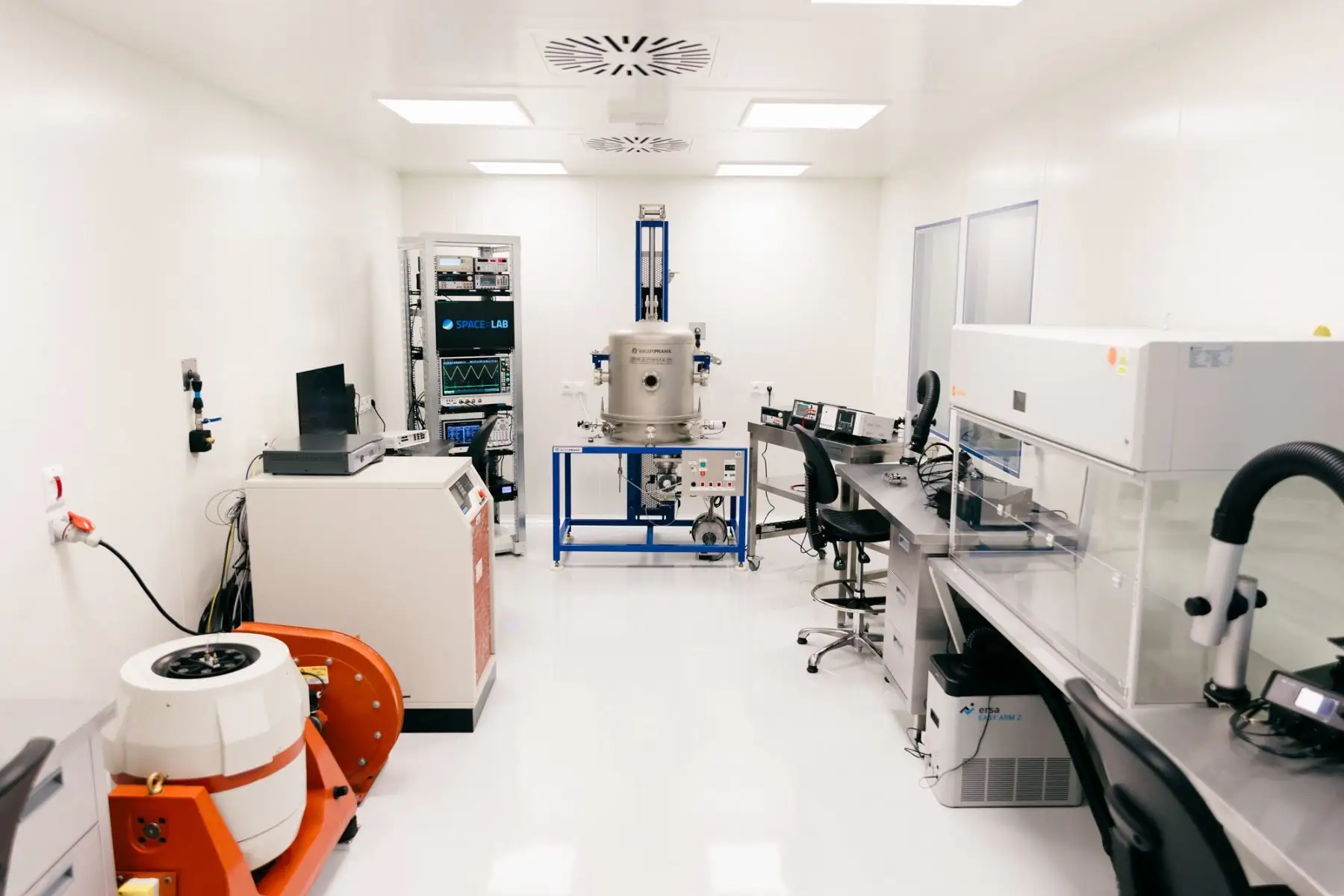
Space cleanroom
Since May 2026, assembly, integration and environmental testing of our flight hardware take place in our own ISO class 7 cleanroom in Košice.
Why a cleanroom
Flight electronics most often fail through contamination and electrostatic discharge: a particle bridges two pads, or an unnoticed discharge damages a junction that later fails in orbit. Neither can be repaired after launch, so the environment is controlled — particle count, temperature, humidity and electrostatic charge.
The room has 25 m² at ISO class 7, with an ISO class 5 laminar box for the most sensitive work. Personnel enter through an air shower, material through a 60 × 60 cm pass-box, and the room is kept at overpressure. Processes follow ECSS, the standards used in ESA projects.
Until 2026, formal test campaigns had to be carried out elsewhere; they now take place in Košice.
Electronics assembly and inspection
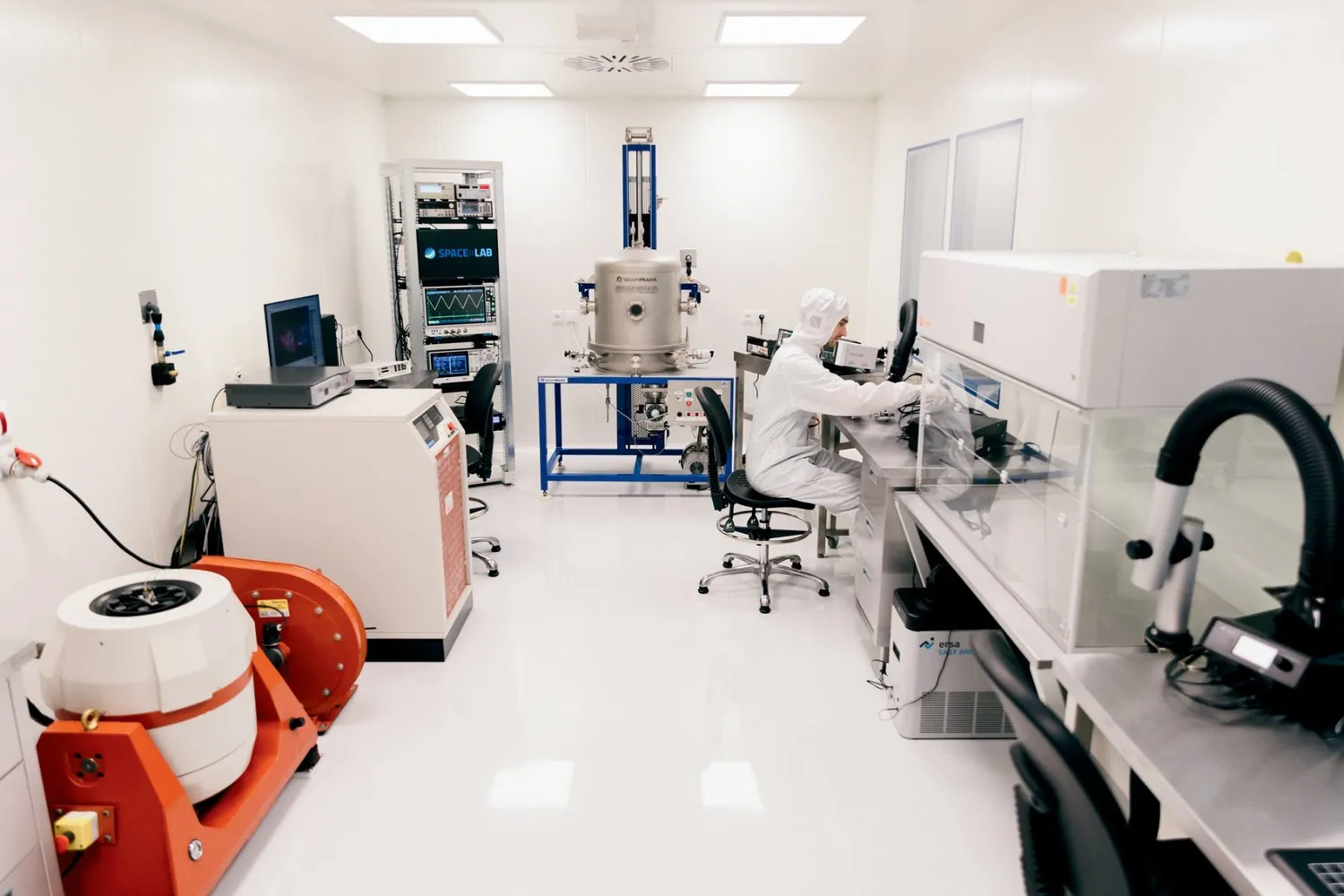
The room is equipped for hand work on flight hardware and for looking at it closely afterwards.
| Soldering | Professional soldering workstations |
|---|---|
| Microscopy | DRV-Z1 3D stereo digital microscope |
| Joint inspection | Ersascope X Inspection System |
| Measurement | Oscilloscopes, power supplies, precision multimeters, function generator, counter |
| Weighing | Analytical precision balance |
The Ersascope inspects, from the side, solder joints hidden under components.
Vibration testing
The shaker reproduces launch loads and exposes weak joints, loose connections and resonances before launch.
| System | Brüel & Kjær LDS V780 shaker, HPA-K amplifier (5 kVA, class D) |
|---|---|
| Frequency | DC – 4000 Hz |
| Sine force | 5120 N peak |
| Random force | 4230 N rms |
| Sine acceleration | 1089 m·s⁻² (111 g) peak, bare armature |
| Random acceleration | 480 m·s⁻² rms |
| Velocity | 1.9 m·s⁻¹ peak |
| Displacement | 25.4 mm peak-to-peak |
| Moving element mass | 4.7 kg |
| Control | 24-bit digital control, IEPE accelerometers |
| High-speed imaging | Chronos 2.1-HD camera |
Maximum system ratings. The usable test envelope depends on payload mass, fixture dynamics, axis and frequency.
Thermal-vacuum testing
The SPACEVAC chamber combines vacuum with temperature cycling to verify thermal design and survival across the full temperature range before flight.
Hardware inside is cycled between −100 °C and +160 °C in vacuum, down to 1 × 10⁻⁷ mbar (empty chamber, +25 °C), and exercised over its flight interfaces while the test runs.
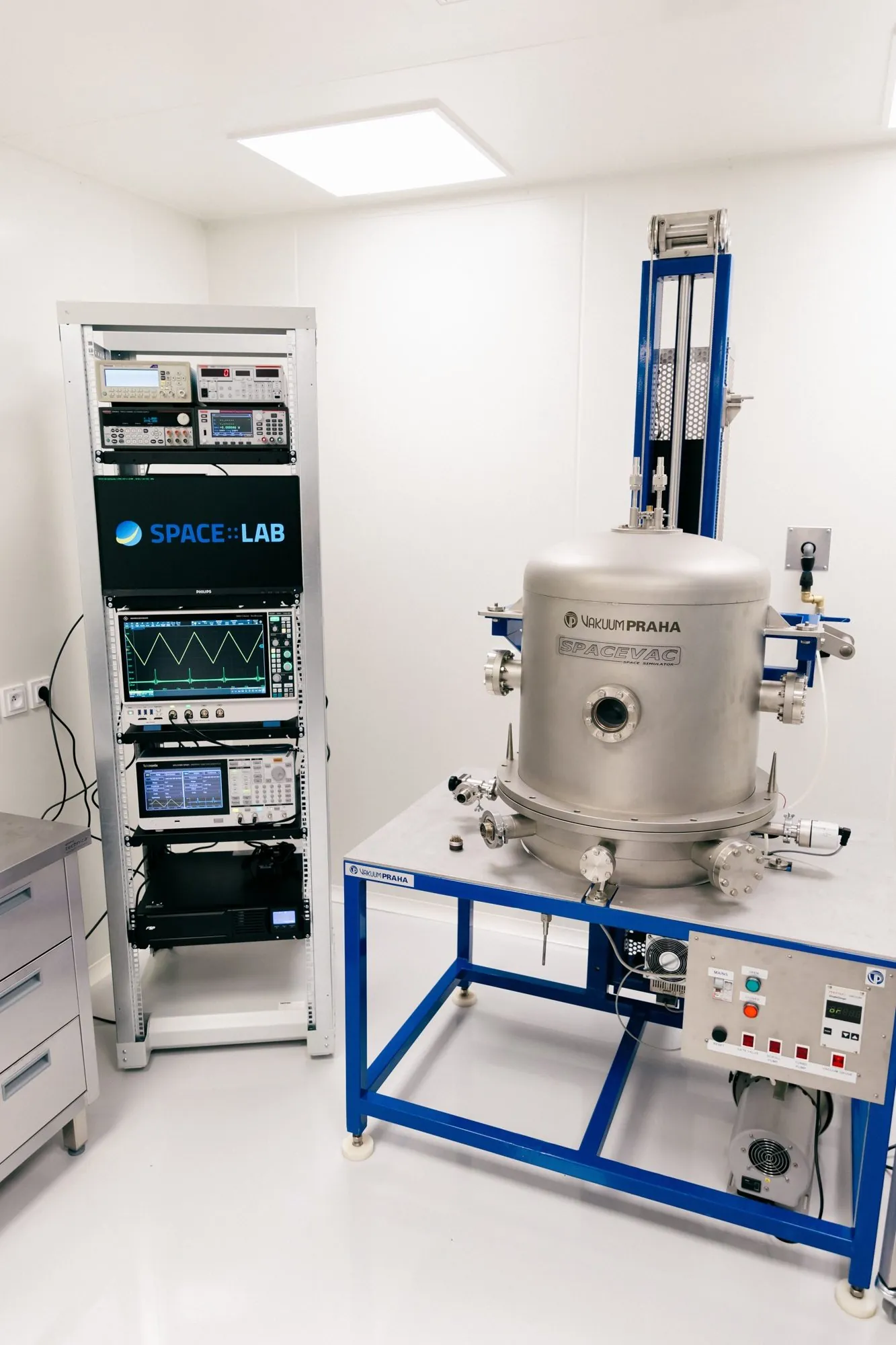
| Chamber | Vakuum Praha SPACEVAC, 150 L bell chamber |
|---|---|
| Thermal interface | Ø 450 mm temperature-controlled copper base plate, radiation shroud |
| Temperature | −100 °C to +160 °C |
| Vacuum | 1 × 10⁻⁷ mbar (empty chamber, +25 °C) |
| Pumping | Varian SH-110 dry scroll pump, Varian V301 Navigator turbomolecular pump |
| Pressure measurement | TPG 261 controller, PKR 251 FullRange gauge (Pirani + cold cathode) |
| Temperature logging | Up to 16 PT1000 channels |
| Feedthroughs | 2 × 32 pins + 4 HV pins at the base, 9 pins in the upper bell |
The chamber has flight heritage: the Anti-Coincidence Module for JUICE was tested in it before delivery to IRF Kiruna. It now stands in the cleanroom.
Test automation and interfaces
Tests are automated with National Instruments modules for temperature, voltage, digital inputs and outputs, and relays.
Units under test connect over flight buses — SpaceWire, MIL-STD-1553, Ethernet, CAN and RS-485/422 — and can be operated during chamber and shaker tests.
Opened in May 2026
The cleanroom opened officially on 14 May 2026 as the first space cleanroom in Slovakia, built with support from TIK STEPHANIK — the satellite platform consortium we are part of — and SAV OPEN LABS, both funded by the European Union.
The first scientific apparatus from our department flew into space in 1977. Since then we have contributed to more than 25 space missions. The new space cleanroom, with ISO class 7 air cleanliness, opens the door to taking part in the most demanding ESA projects — and it lets us carry out the critical phases of development and testing here at home.
Šimon Mackovjak, Head of the Department of Space Physics, IEP SAS
The opening was attended by guests from the Slovak Academy of Sciences, the STEPHANIK project consortium, the East Slovak Space Cluster, the Slovak Space Office, and partner universities and companies.
Working with us
Capacity is divided three ways. The facility serves the space programme of IEP SAS first. A share is reserved for joint scientific and technological projects. A further share is available for commercial hire.
If you are developing hardware that needs ISO class 7 assembly, vibration qualification or thermal-vacuum testing — as a research partner or as a customer — write to space-lab [at] saske.sk.
Talk to us about access
Tell us what you need to measure or test. Both facilities are open to partners under SAV OPEN LABS (2026–2029, Programme Slovakia 2021–2027 · ERDF); hosting at Lomnický štít and use of the cleanroom are agreed case by case.