1957
The beginnings of the space program
The roots of space science in Košice trace back to the 1950s, closely tied to early cosmic ray observations and the construction of the space physics laboratory at the peak of Lomnický štít in 1957.

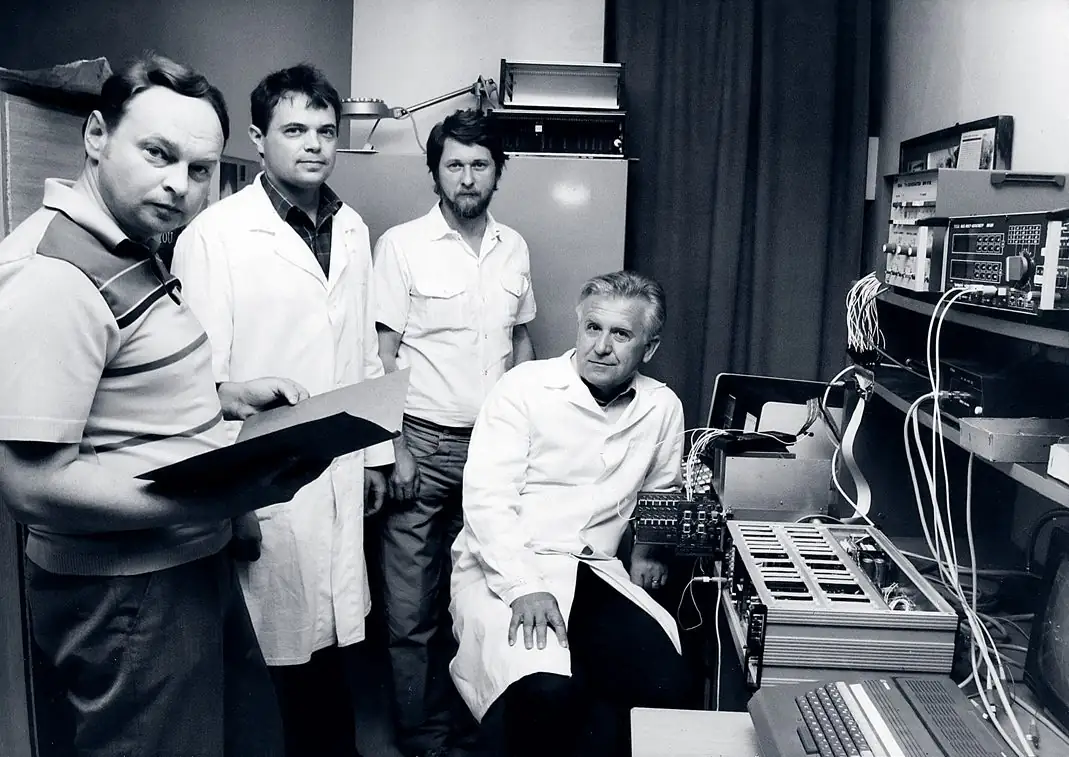
Our work began with cosmic ray research at Lomnický štít and continued within the Interkosmos programme. Today we build instruments for ESA missions, operate a cosmic ray station on Lomnický štít and apply machine learning to space weather.
To understand the physics of space — cosmic rays, space weather, and airglow — through measurements from space and from the ground, and to share that knowledge openly.
The roots of space science in Košice trace back to the 1950s, closely tied to early cosmic ray observations and the construction of the space physics laboratory at the peak of Lomnický štít in 1957.
Following the establishment of the IEP SAS, Košice physicists joined the Interkosmos program. The first instrument developed entirely within the department — the SK-1 gamma-ray and neutron detector — launched on 24 September 1977 aboard Interkosmos-17.
The DOK series of semiconductor detectors was deployed across many international missions — including Prognoz-8, Intershock, Active, Interball, and Magion — alongside the SONG instrument electronics aboard the Coronas satellites (1994, 2001).
The department expanded into theoretical modeling of cosmic ray propagation through the heliosphere and magnetosphere, and developed research on the links between space weather and cosmic ray fluxes. Integration with European labs accelerated with SLED-2 for the Mars-96 mission.
Collaboration expanded to the ESS communication processor for ESA's Rosetta, the NUADU energetic neutral atom imager for Double Star, the MEP-2 spectrometer for Radioastron, the PICAM ion mass spectrometer for BepiColombo, and the PEP package for JUICE.
The scientific portfolio expanded to ultra-high-energy cosmic rays (up to 10²⁰ eV) through the global JEM-EUSO collaboration. This milestone also introduced the study of airglow — the intrinsic emission of Earth's upper atmosphere — into the department's core research.
Machine learning became a core method for processing large image datasets and predicting space weather. We contribute to ESA's Space Safety Programme, prepare datasets for the ESA Vigil mission and take part in KM3NeT.
We opened the first space cleanroom in Slovakia: ISO class 7, ESD-protected, with controlled temperature and humidity, for building and testing spaceborne hardware to ECSS standards.
← Drag or scroll to move through the timeline →

Airglow · Space weather · Machine learning · Data science
mackovjak [at] saske.sk
Research focus
jan.balaz [at] saske.sk
Research focus
bobik [at] saske.sk
Research focus
langer [at] saske.sk
Research focus
strharsk [at] saske.sk
UHECR · Neutrino astrophysics · Simulation frameworks
slavo [at] saske.skResearch focus
stefanik [at] saske.sk
Radiation protection · Dosimetry · Cosmic rays · Space weather
kubancak [at] saske.sk
Research focus
truska [at] saske.sk
Cleanroom · Environmental testing · Space hardware AIT
fecko [at] saske.sk
Embedded electronics · Space hardware
usatiuk [at] saske.skResearch focus
valent [at] saske.sk
IT infrastructure · Networking · Cybersecurity
hinzburh [at] saske.sk
Research administration · Grants · Procurement · Travel
dolinicova [at] saske.skResearch focus
stetiaro [at] saske.sk
Space weather · Machine learning · Data science
kostarova [at] saske.sk
Neutrino astrophysics · Software development
haneszova [at] saske.skResearch focus
villim [at] saske.sk
Onboard ML software · Space weather applications
maddox [at] saske.skPavol Jozef Šafárik University in Košice
randuska [at] saske.skTechnical University of Košice